Finance and costs20:06
A local AI model reads contracts and quotes starting from 25,000–60,000 PLN
The cost of self-hosting an 8B–13B model to process contracts and quotes, implementation timelines, and what to test on 100 scans before buying a server.

Listen to the article summary
Synthetic voice.Below is a practical guide, not legal or formal advice; for larger budgets, review it with your own advisor. In an 80-person manufacturing company, the COO receives 600–800 scans every month: supplier contracts, offers, acceptance protocols. Two employees copy amounts, deadlines, and parties into a spreadsheet, while legal counsel reviews clauses one by one. Scans never go to any external API because the board refuses to send documents off-site. The question is how much it costs to deploy an 8B–13B model on-premise and how many weeks it takes before the system starts processing Polish scans.
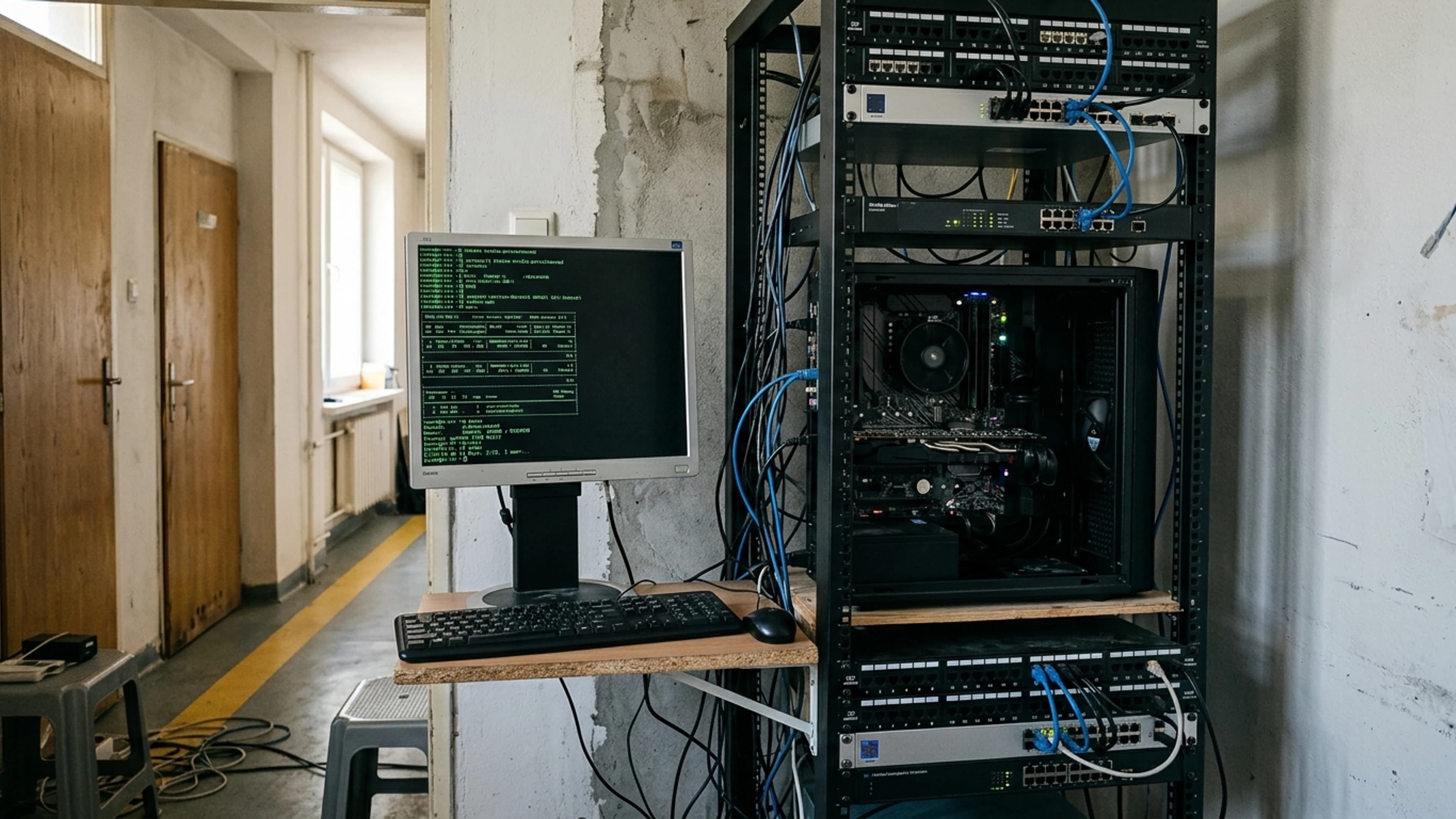
The minimum server specification to run a contract-reading model is 16 CPU cores, 64 GB RAM, 24 GB VRAM, and a 2 TB NVMe drive with full-disk encryption. A used workstation with an RTX 3090 card and 64 GB RAM costs 22,000–28,000 PLN; a new server with an RTX 4000 Ada and an encrypted 2 TB drive costs 45,000–60,000 PLN. In our experience, on-premise hardware becomes cost-effective at 700–900 pages per month; at 200–300 pages, an API is often cheaper and simpler.
What you can do this week
Step 1: document type audit. Two days, handled by the office manager or executive assistant. List 6–8 recurring types: lease agreement, supply offer, NDA, acceptance protocol. Step 2: collect 100 scans. One day, done by an administrative staff member. Standard 200 dpi PDFs straight from the scanner are enough; no labeling or sorting required. Step 3: test the model on existing hardware. Two days, handled by an IT specialist or external technician. Run a quantized 8B model on CPU, with no new server and zero hardware budget: total cost is 8–10 billable hours. Step 4: read 10 contracts and verify manually. One day, done by legal counsel or a contract coordinator. Record which fields from the original the system extracted correctly and which it missed.
What to avoid doing right away
Do not buy a 60,000 PLN server before testing accuracy on 100 scans. Initial results will reveal whether issues stem from scan quality rather than model power. Do not integrate with your ERP or document management system right away; this integration usually costs 15,000–30,000 PLN and adds 3–4 weeks, yet it is not needed to measure accuracy. Do not start with a 70B model either; an 8B–13B model is sufficient for extracting fields from Polish contracts, while a larger model requires hardware that costs 4–5 times more. Compliance procedures under the AI Act do not need to be completed before testing, but you should use an encrypted drive from day one.
How to verify it works after two weeks
Two weeks after kickoff, track a single metric: the rate of correctly extracted fields on a sample of 100 scans. Count only the fields destined for the spreadsheet: date, parties, amount, deadline, contract number. The benchmark we target in tests is 95% correct fields compared to manual review. The ExtrAct team reported a similar threshold, nearly 95%, for notarial deeds. If the score falls below 90%, halt the server purchase and inspect scan quality or simplify the document type. A score between 90% and 95% means you need to refine the extraction template rather than buy a faster GPU.
If you decide after testing that your team lacks time for deployment, outsource it. At HEXART, we set up an on-premises model on your hardware, connect OCR and extraction templates, and deliver a live pipeline with monitoring within 4–7 weeks. No documents leave your infrastructure. Learn more about deployment: solutions.
Source materials
Sources consulted during research. The text above is our own; these third parties are not responsible for its content and have not authorised it.
- Ustawa z dnia 3 lipca 2026 r. o systemach sztucznej inteligencji
- Tekst ustawy przekazany do Senatu zgodnie z art. 52 regulaminu Sejmu
- o rządowym projekcie ustawy o systemach sztucznej inteligencji (druk nr 2443)
- ExtrAct - nowe narzędzie AI do obsługi dokumentów dla polskich urzędów - Ministerstwo Cyfryzacji - Portal Gov.pl