Law and regulations20:08
Employees can use ChatGPT at work, but not on a free account
This guide explains when employees can use ChatGPT at work and what must be included in company policies: from Team/Enterprise plans to forbidden data lists and Labor Code sanctions.

Listen to the article summary
Synthetic voice.An open guide straight from our practice. We share direction and concrete numbers, while you make the call on your own terms. The thesis we hear most often in office and service companies of 20–150 people is: ChatGPT at work is acceptable, just ban pasting personal data and collect a signed statement. This sounds reasonable: Polish labor law has no specific clause banning ChatGPT, and the Labor Code lets employers define how work is performed. The trouble starts when someone turns that single sentence into an entire procedure.
The strongest counterargument
This argument is not a straw man. Indeed, GDPR does not explicitly ban ChatGPT, and the AI Act does not regulate the regular employee as a deployer. If an employee pastes only anonymized data, Article 9 GDPR risks drop, and the employer retains Labor Code remedies: from an official warning to immediate termination for cause under Article 52 §1 point 1. Disclosing trade secrets carries up to 2 years of imprisonment. In a small company without IT, this feels convenient: one A4 page, a signature, and the problem seems solved.
What this argument overlooks
It ignores that a free ChatGPT account operates outside GDPR standards: content can be used to train the model and moves to servers outside the EEA, and pasting content does not establish an Article 28 GDPR data processing agreement. An employee consent form is not a valid legal basis for processing employee or client data. A signed statement does not shift the controller accountability obligation onto the employee. In our practice, the data that leaks is rarely a national identity number; it is usually offer contents, price lists, contracts, or client messages: which fall under trade secrets, not just personal data. In a company without IT, the question remains: who assesses whether a SaaS tool includes a DPA, disabled training, and reasonable data retention? An employee cannot do this, as it is outside their role.
Our position
Our position: an employee may use ChatGPT for work, but only after tool evaluation, designation of an approved version, and training: a policy is a condition of compliance, not mere paperwork. In our practice, onboarding a 20–100 person company begins with three questions: who uses it, for what purpose, and what data enters the system. Next, an external DPO or law firm evaluates ChatGPT Team or Enterprise regarding the DPA, non-EEA transfers, retention, and model training opt-outs. Reviewing a single tool typically takes 2–4 business days at 300–600 PLN net per hour, and basic training requires 1.5–2 hours. The decision is made neither by the employee nor by an external IT vendor: the process owner, COO, or HR submits the request, and the COO or board approves it. We reserve the free version strictly for generic testing without company data; we deploy team accounts with training disabled for business operations.
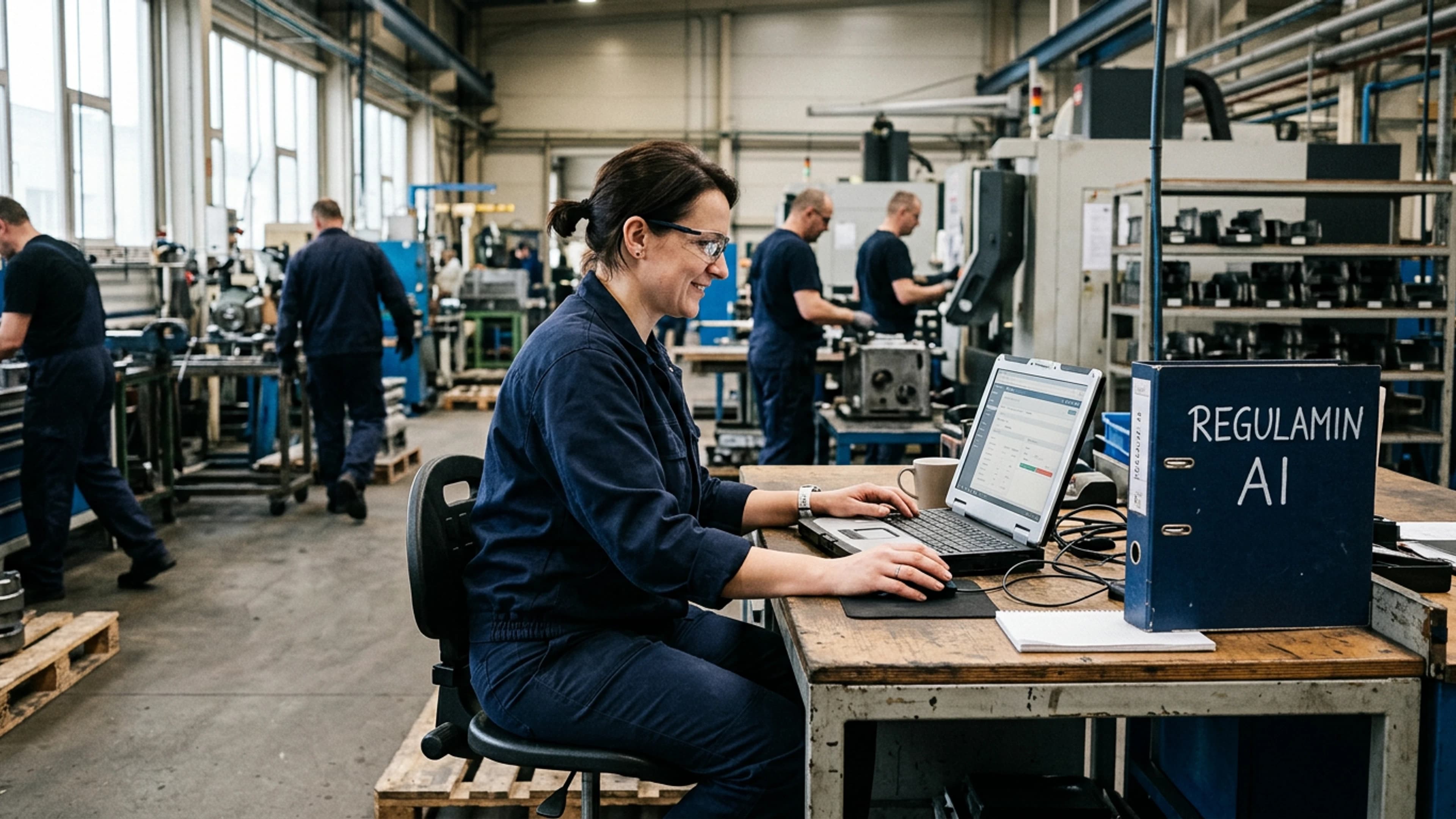
What to include in the policy then
We include eight points in the policy: purpose and definitions; permitted versions and use cases; prohibited data and operations; rules for processing data without employee consent as a legal basis; reporting procedure for tools; user duties and AI literacy training pursuant to Article 4 of the AI Act; tool and incident register; audits and sanctions. The prohibited list includes PESEL, NIP, addresses, phone numbers, bank account numbers, GDPR Article 9 and 10 data (health, biometrics, religion, racial or ethnic origin, criminal convictions), salaries, performance evaluations, children's data, passwords, API tokens, pricing, proposals, contracts and NDA content. Employee sanctions range from an admonition or reprimand under Articles 108–113 of the Polish Labour Code, through liability for damages up to 3 months' salary for unintentional damage and full compensation for intentional damage, to summary dismissal under Article 52 § 1 point 1. The company risks UODO fines up to 20 million EUR or 4% of annual turnover. Action for this quarter: if the company runs on free accounts, immediately cut off company data from them and move tests to a segregated environment. We would reconsider if a free tier offered a DPA, disabled model training and EEA processing: that would change the risk assessment.
Source materials
Sources consulted during research. The text above is our own; these third parties are not responsible for its content and have not authorised it.